Create and manage a labour conditions proposal
Start from: The Workforce module.
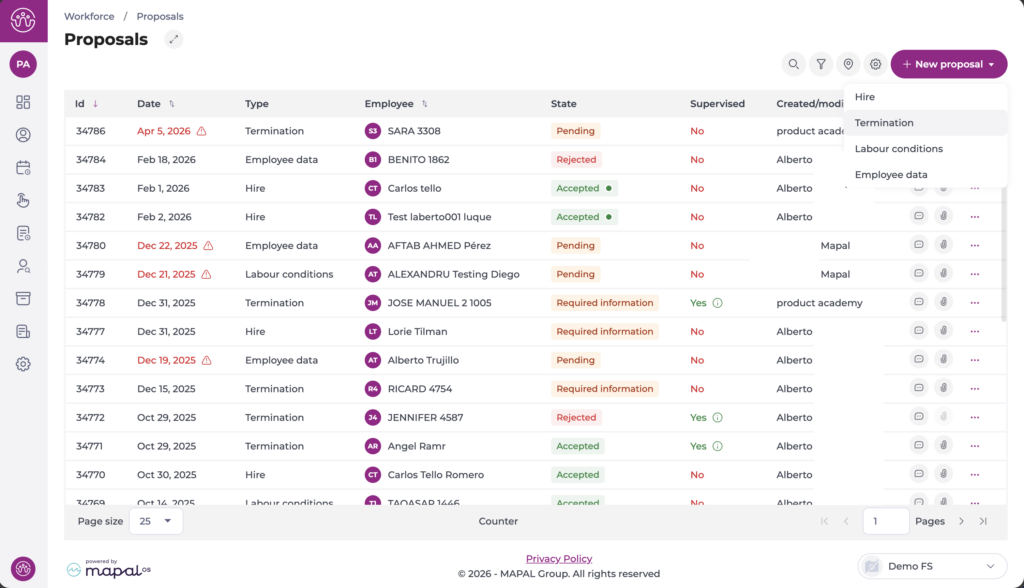
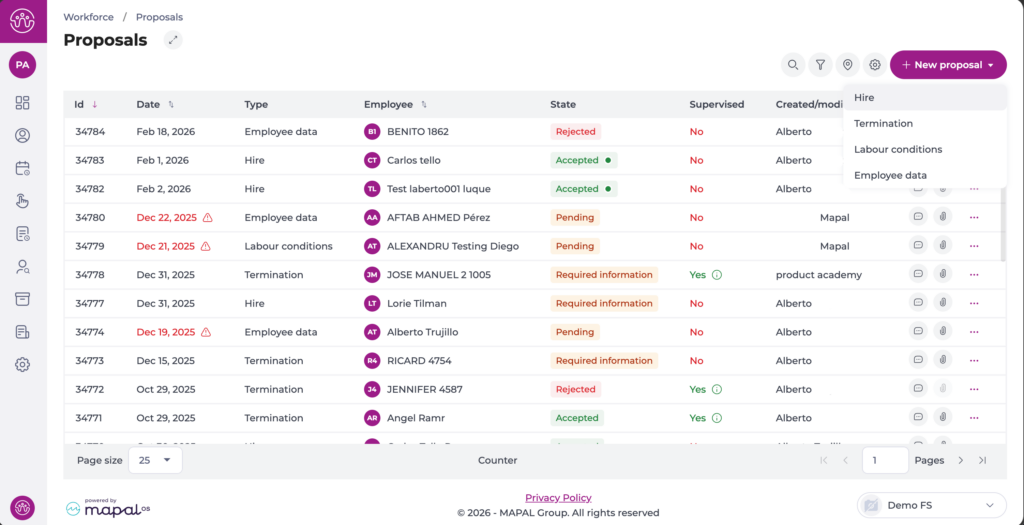
- Navigate to Workforce management > Proposals 2.0.
Create a labour conditions proposal
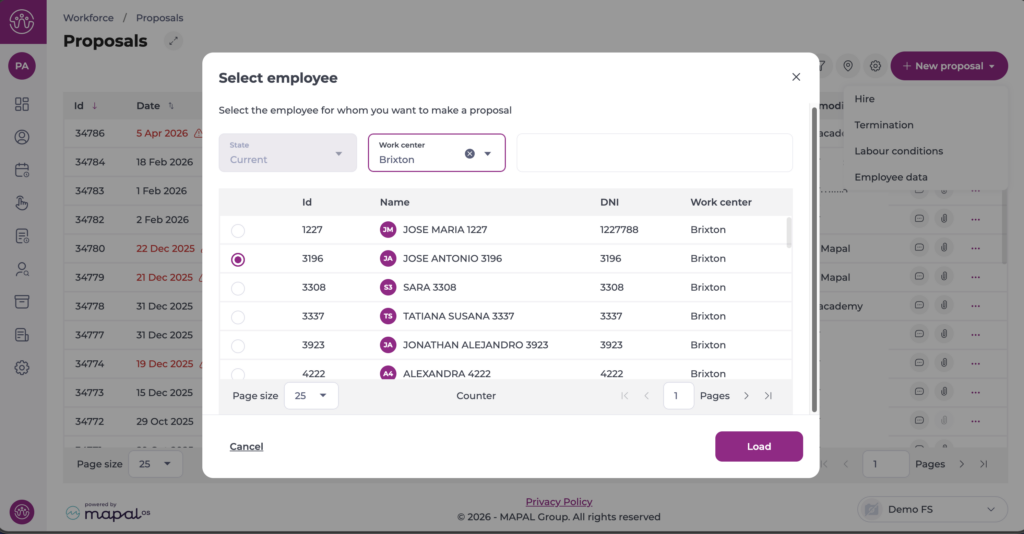
- Select + New proposal.
- Select Labour conditions from the dropdown.
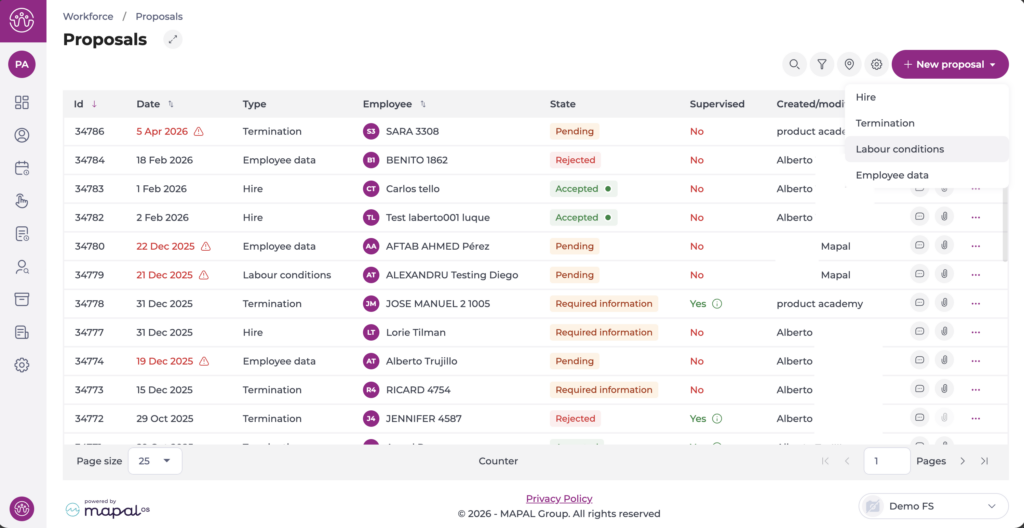
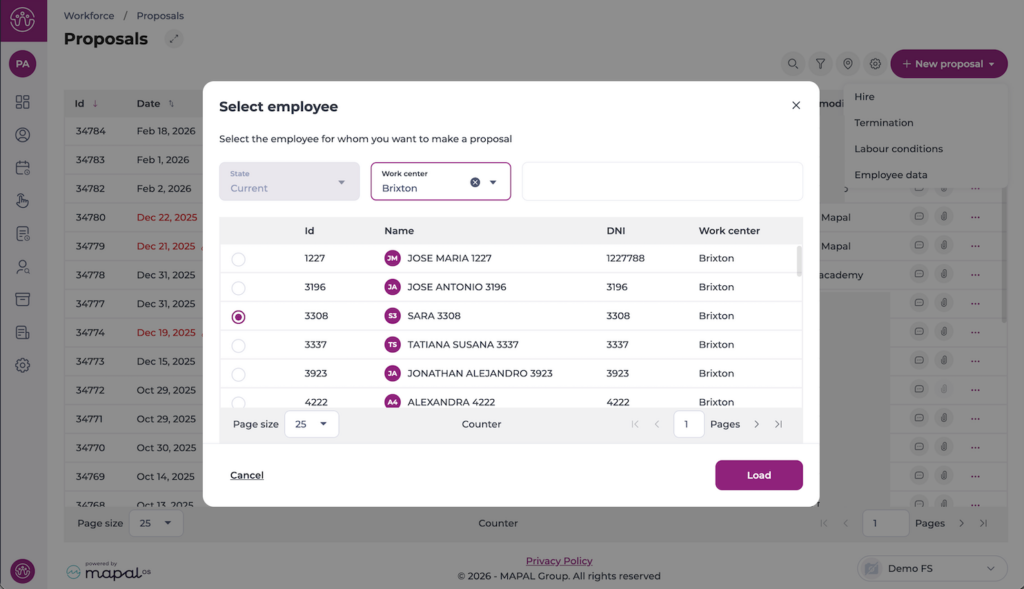
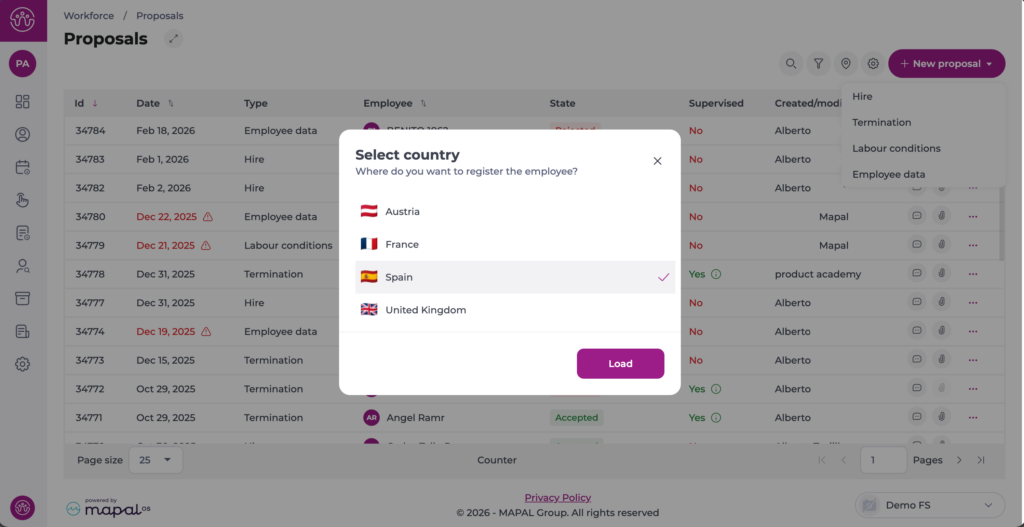
A Select employee dialogue appears. This displays a list of current employees. You can filter the list by State and Work centre to narrow down the results. Select the employee you want to create the proposal for, then select Load.
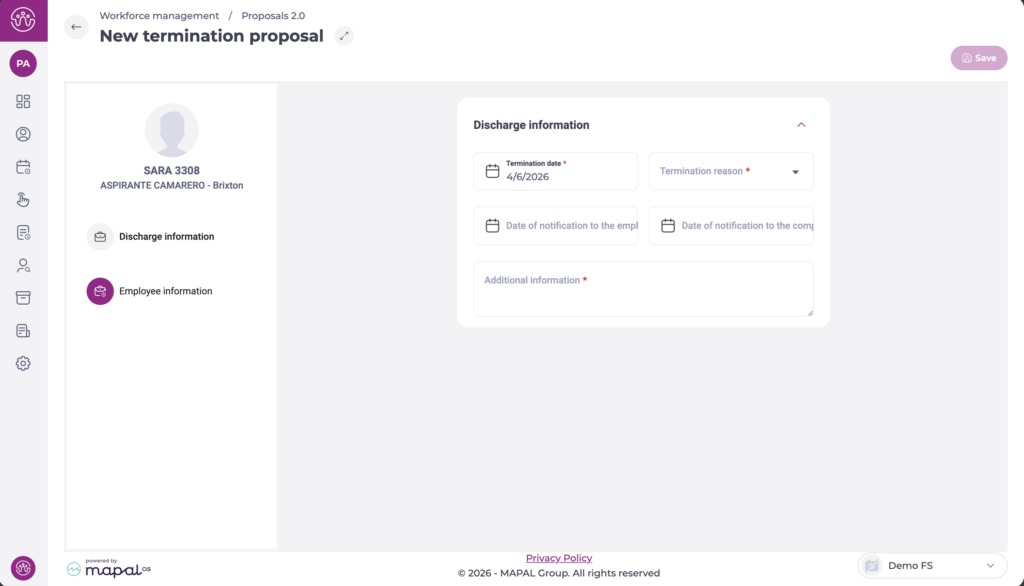
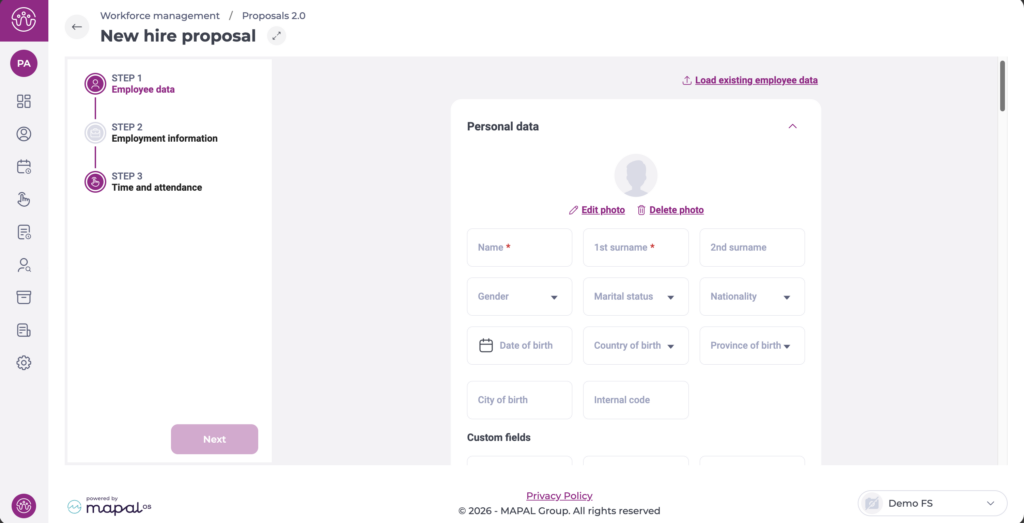
The system opens the New labour conditions proposal form. The left-hand panel displays the employee's name, role, and business unit, along with two navigation sections: Employee information and Employee history.
Employee information
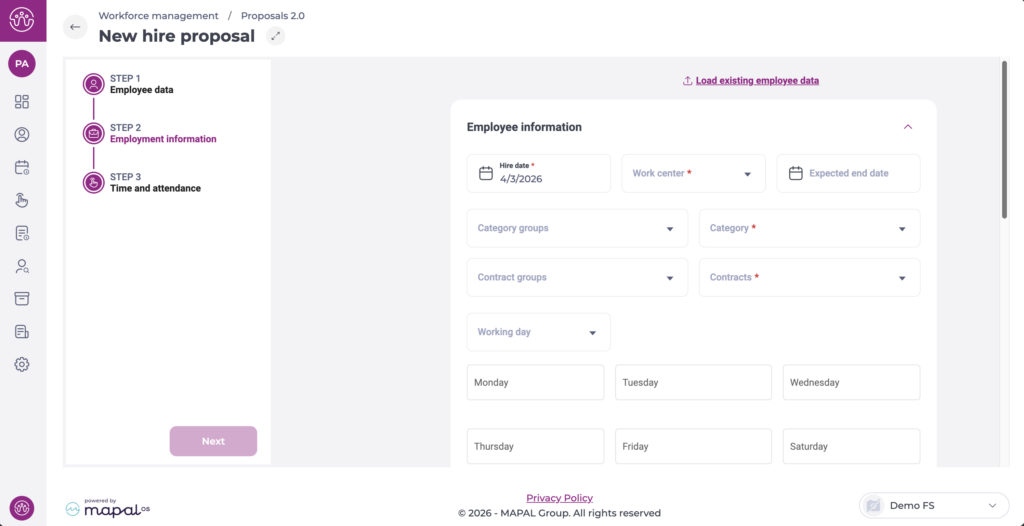
Select Employee information in the left-hand panel to update the employee's contractual details. Required fields are marked with an asterisk (*). The form pre-fills with the employee's current values.
- Select the Hire date *. This reflects the start date for the new conditions.
- Select the Work centre * from the dropdown.
- Select the Expected end date and Expiration date if applicable.
- Select the Category groups and Category * from the dropdowns.
- Select the Contract groups and Contracts * from the dropdowns.
- Select the Working day type from the dropdown.
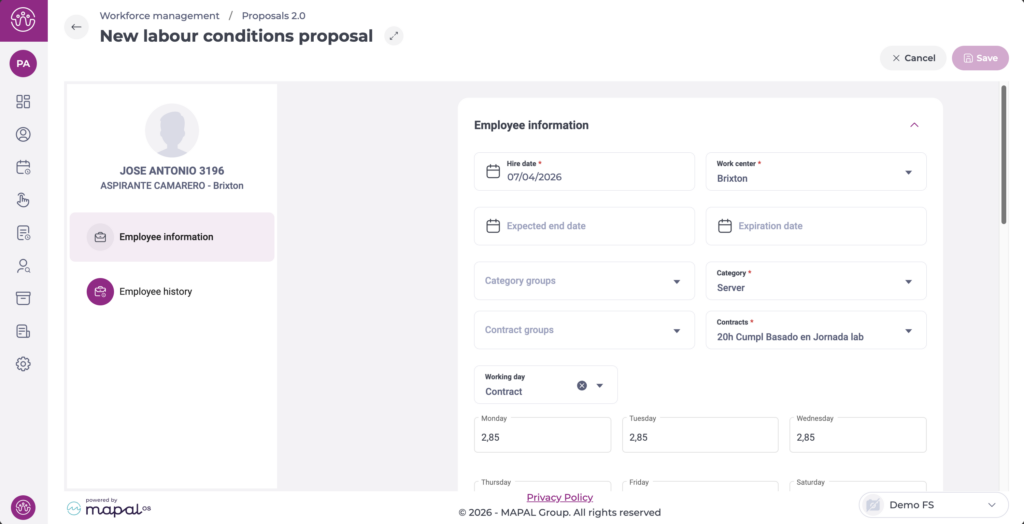
- Enter the number of contracted hours for each day of the week (Monday through Sunday). The Total field updates automatically.
- Enter any relevant details in the Additional information * field.
- Select the Contractual documentation checkbox if contractual documents need to be generated for this change.
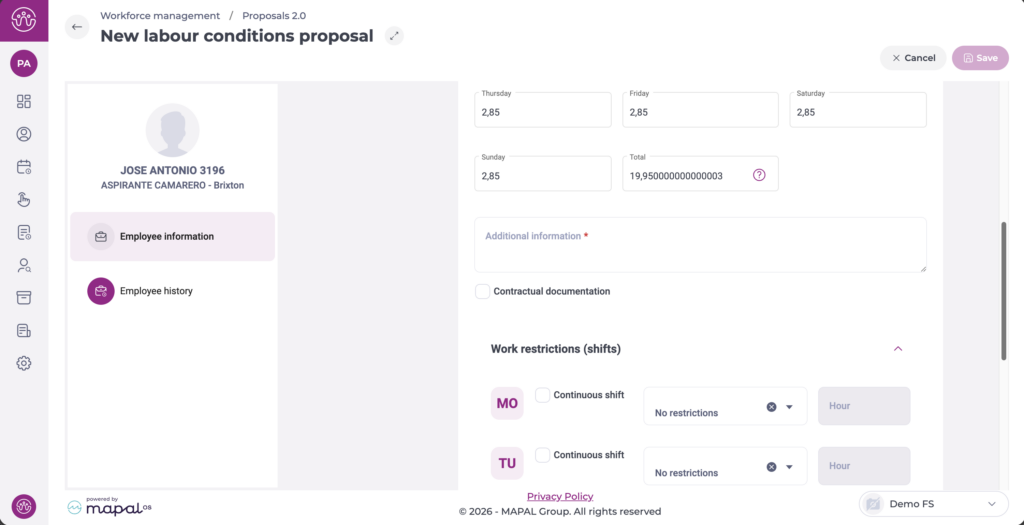
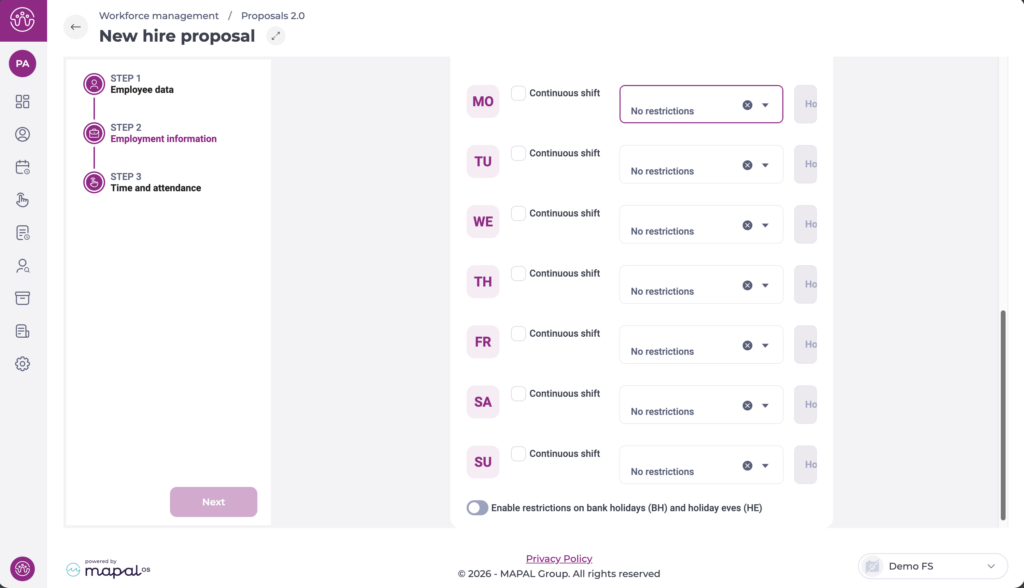
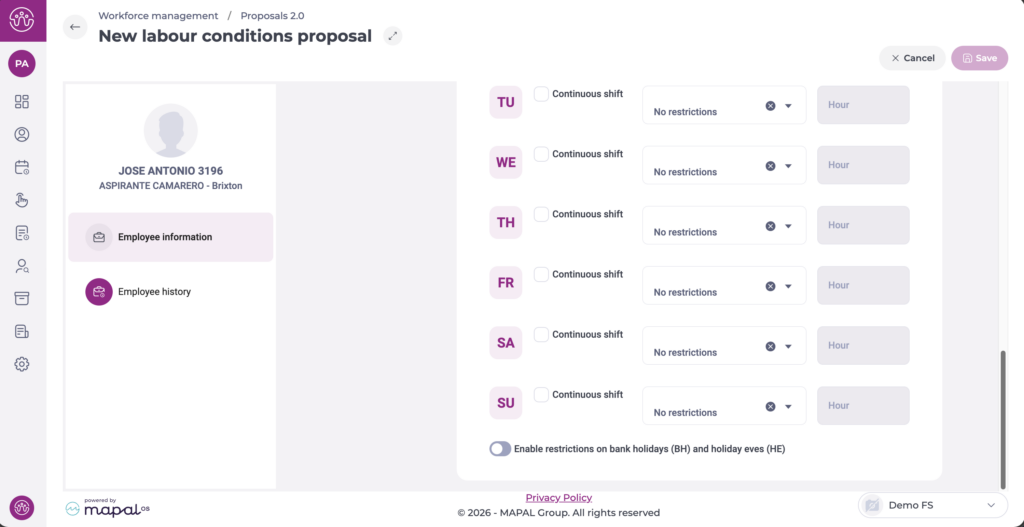
- Set Work restrictions (shifts) for each day of the week (MO, TU, WE, TH, FR, SA, SU):
- Select the Continuous shift checkbox if the employee works a continuous (non-split) shift on that day.
- Select a restriction from the dropdown. The default value is No restrictions.
- Enter a value in the Hour field if a specific start time applies.
- To apply restrictions on non-working days, enable the Enable restrictions on bank holidays (BH) and holiday eves (HE) toggle.
Employee history
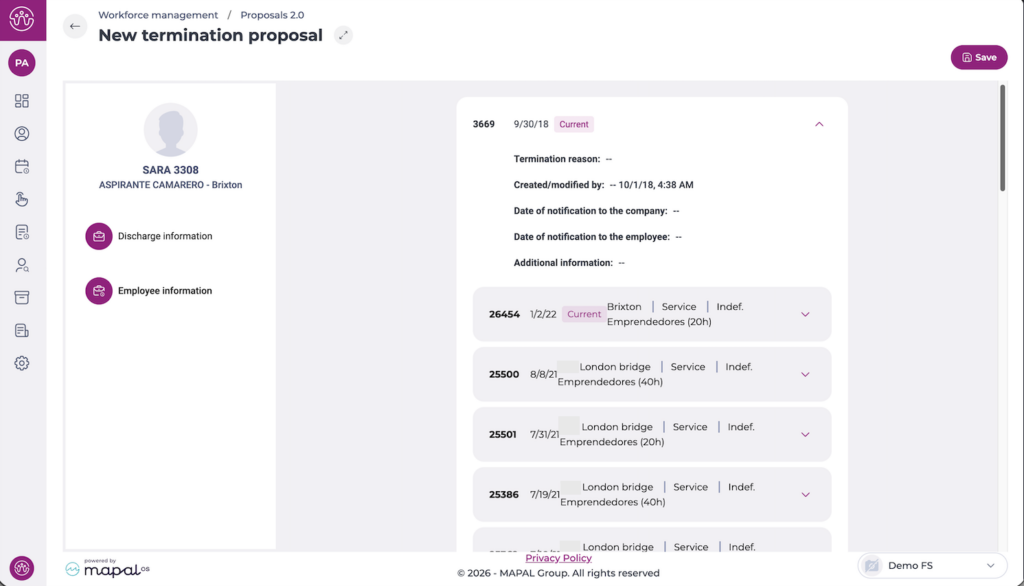
Select Employee history in the left-hand panel to review the employee's current and historical employment records. Each record shows the employee ID, start date, business unit, role, contract type, and contracted hours. Select the expand arrow on any record to view further details such as the termination reason and created/modified information.
This section is read-only and is provided for reference when processing the change.
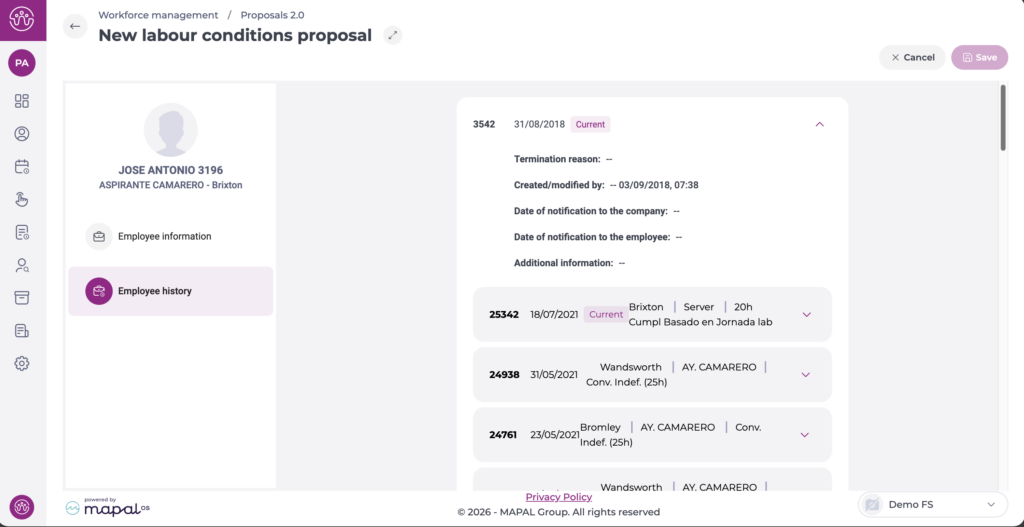
Once you have completed the employee information, select Save to submit the proposal. Select Cancel to discard the proposal without saving.
Manage a labour conditions proposal
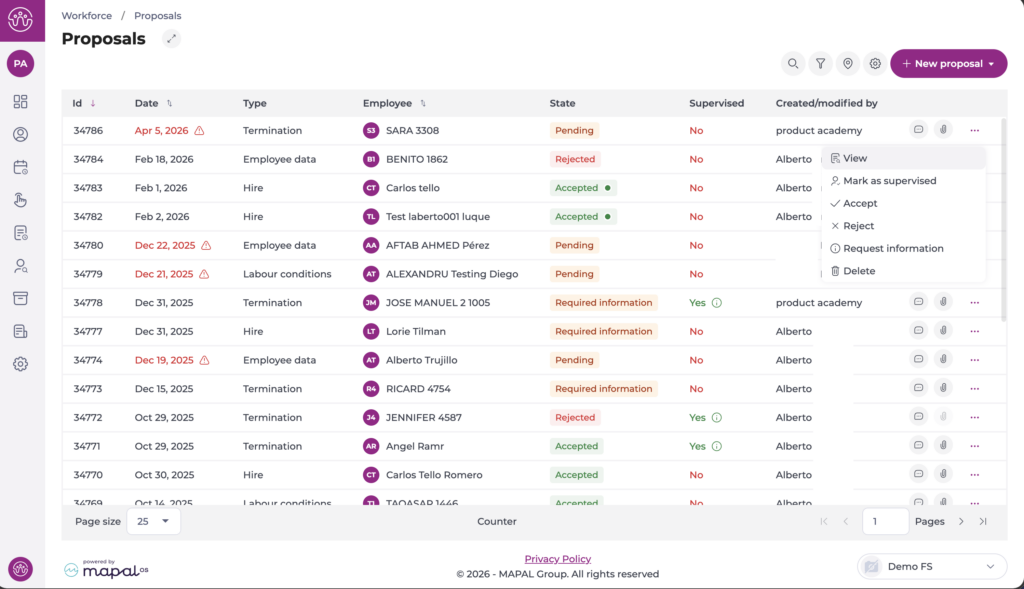
Once submitted, the proposal appears in the Proposals list with the type Labour conditions and the status Pending.
Actions menu
Select the three-dot icon (...) on the proposal row to open the actions menu. The options available depend on the proposal's current status and your permissions:
- View: Opens the proposal in read-only mode.
- Mark/Unmark as supervised: Flags the proposal as reviewed.
- Accept: Approves the change. A confirmation dialogue warns that this action is final and cannot be reversed. Select Accept to confirm.
- Reject: Declines the change. A confirmation dialogue warns that this action is final and cannot be reversed. Select Reject to confirm.
- Request information: Returns the proposal to the creator for additional data or corrections. The status changes to Required information.
- Delete: Permanently removes the proposal from the system.
Note: Accepting or rejecting a proposal is irreversible. Review the proposal details carefully before confirming either action.
More actions on the proposal
To know more aboutgeneral navigation and actions in the proposals grid, see Get familiar with the Proposals screen.
Note: The actions available depend on your role and permissions. If you cannot see a specific action, contact your administrator to review your role configuration under Workforce > Configuration > Roles. For more information on role management, see Configure permissions for workforce management.